


On November 5th, 2026, ASAPbio co-hosted a Community Call with Declaration on Research Assessment (DORA) and openRxiv. The call focused on the urgent need to align research assessment and scholarly publishing reform activities.
The meeting started with Giovanna Lima, Program Manager at DORA, who discussed DORA’s efforts to create a new resource, “A Practical Guide to Implementing Responsible Research Assessment in Scholarly Communication.” Giovanna began with DORA’s history, its work to improve research assessment, and its two recent impactful guides for Research Performing Organizations (2025) and Funders (2026). Those two guides, along with the upcoming one, are designed to be helpful, practical, flexible, step-by-step approaches to implementing research assessment principles.
The upcoming Guide is aimed at a diverse audience, from preprint platforms, publishers, libraries, repositories, infrastructure and metadata providers, and research communication and dissemination services to research policy and integrity organizations. Like its predecessors, the upcoming Guide is meant to guide users in developing interventions and strategies that can be adapted to a given institution, department, or organization. Previous guides include practical tips and resources from the Community. DORA also aims to include practical advice in the newest Guide; therefore, it is asking the Community’s help to shape it.
Giovanna’s talk was followed by a presentation from Tracy Teal, CEO of openRxiv. Tracy explained how preprints can lead the way in responsible assessment of scholarly communication, since preprint servers have the freedom to pursue and experiment with new technologies and strategies. openRxiv has a dedicated experimental space – openRxiv Labs – to pursue such projects. Their first experiment is with Curvenote Reader, which takes the author-submitted PDF and breaks it into research components, making them more visible, interactive, and engaging.
Tracy also presented existing features on bioRxiv and medRxiv that help with broader research evaluation. These are trust signals that can tell a reader what the paper includes, e.g., open reviews, available data, and code that was automatically checked and runs, adding more trustworthiness to the preprint.
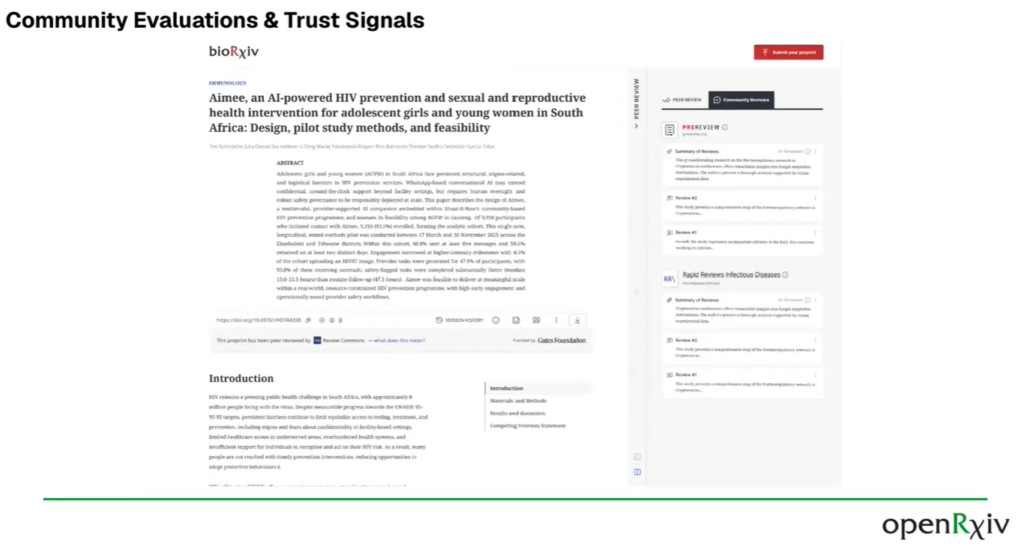
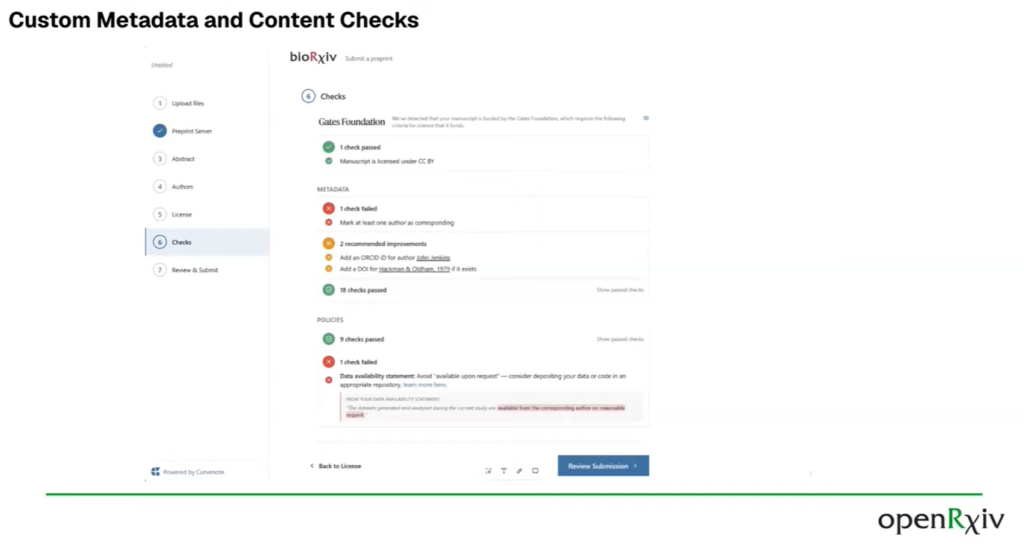
Tracy stressed at the end that what she presented shows real actions and tools that universities and funders can use right now to apply DORA-recommended responsible research assessment metrics to evaluate researchers in a better, more responsible way.
The talks were followed by a discussion among the call participants. It started with the question, “What actions can the preprint and open infrastructure community take in support of responsible research assessment?” This was followed by a discussion of case studies that show features, services, practices, tools, etc. that support responsible research assessment. The Call ended by discussing the resources DORA and others in the RRA community could provide to help our community contribute to achieving our shared goals.
A few people shared ideas regarding research assessment during tenure and promotion. Participants suggested changes to promotion and tenure evaluation that would reduce reliance on journal impact factor and place more emphasis on open science practices; one participant gave an example of such practices at HHMI, such as masking journal names in assessments and recognizing preprints in employee assessments. Additionally, HHMI’s Immediate Access to Research policy requires researchers to post initial and revised preprints. Another participant gave an example of the University of Calgary, which integrated DORA language into tenure and promotion guidelines.
Others also discussed scaling up practices such as open peer review, since posting peer reviews alongside manuscripts can provide information about the study’s quality, and improving the utilization and credibility of existing services and initiatives such as ORCID profiles by enabling the posting of profile reviews.
We encourage you to watch the recording of the Call on YouTube.