


Guest post by Kaitlin Fuller and Ana Patricia Ayala
Paper mills have become an increasingly visible challenge for scholarly publishing and research integrity. They operate within a wider research ecosystem shaped by publishing practices, institutional expectations, and the incentives that influence how research is communicated and evaluated. In this guest post, Ana Patricia Ayala and Kaitlin Fuller share their journey with a team of Canadian librarians to introduce a free online learning module developed to help researchers, students, and other members of the scholarly community better understand paper mills and their consequences. The module explores how paper mills function, why they threaten the integrity of the research record, and how greater awareness can help strengthen trust in research. The module is free to use, under the Creative Commons BY-NC-SA.
Who is educating researchers, librarians, and institutions about paper mills?
This question began for Kaitlin after a 2024 conversation at the Research2Reader conference in London. She was participating in a discussion about peer review when colleagues from across the scholarly publishing industry began talking about the burden of paper mill detection. For Kaitlin, a scholarly communications librarian, the conversation was humbling. She had previously assumed this issue involved only a small number of individuals, without understanding the scale and sophistication of paper mill operations.
When she returned to Canada, she began speaking with colleagues about how researchers might be supported in navigating this rapidly evolving landscape. A group of interested librarians, primarily from scholarly communications and health sciences backgrounds, came together to learn more. Their first step was simple: find a free resource that could help start discussions with faculty members and graduate students. Instead, they found dense technical literature and little practical guidance.
As the group explored the issue further, it became clear that awareness of paper mills remains fragmented across the scholarly communications landscape. It also became evident that paper mill operations directly impact a range of industries and is not a challenge that belongs solely to publishers, institutions, or libraries.
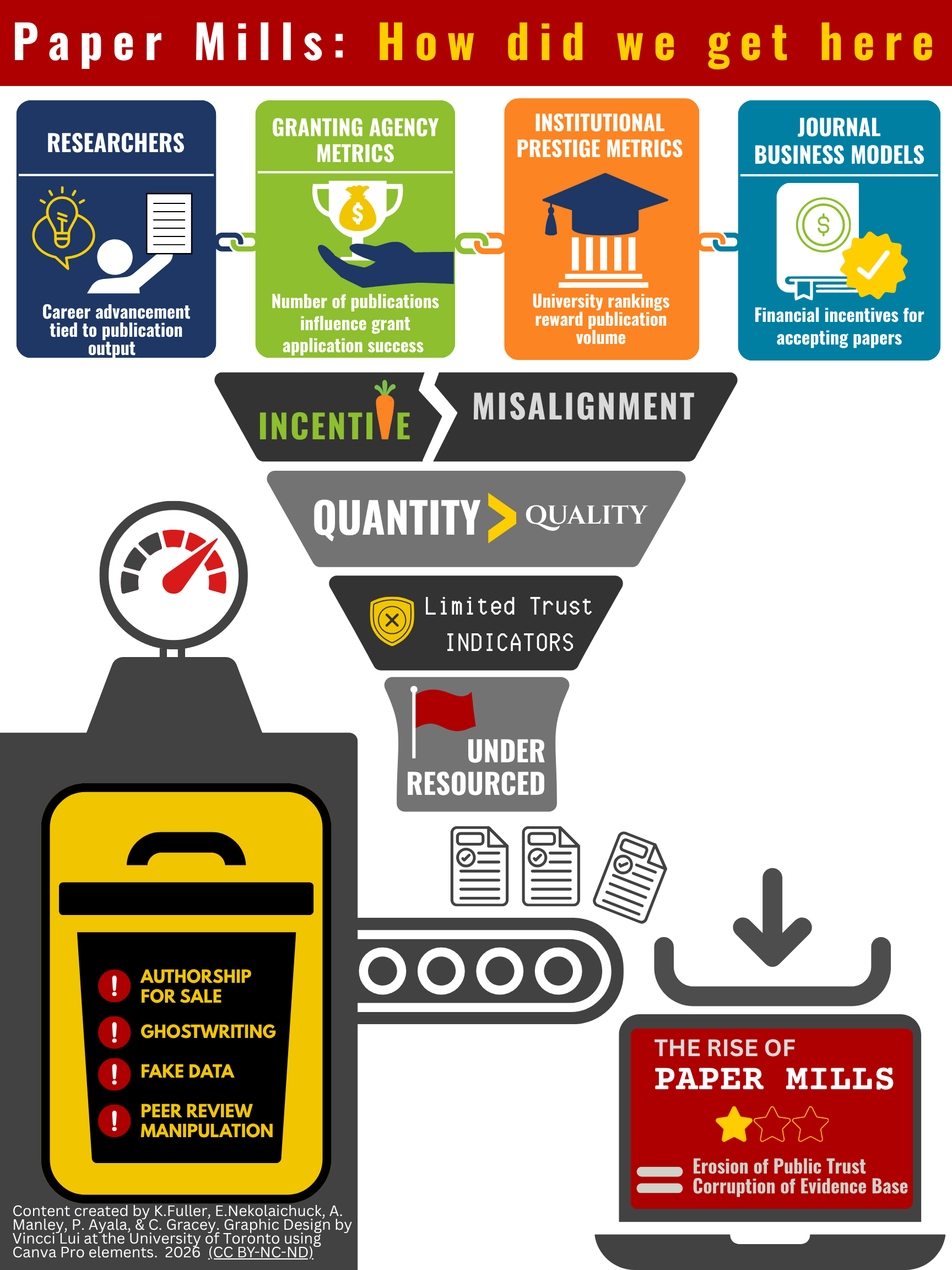
Paper mills do not exist in isolation. They thrive in environments that reward publication output without sufficient attention to research quality, transparency, integrity, mentorship, and other meaningful scholarly contributions. In addition to being a publishing and research integrity issue, paper mills are also a research assessment issue. When researchers face strong incentives to publish and organizations rely heavily on quantitative publication-based metrics to evaluate success, demand can emerge for these services that manufacture fraudulent scholarly outputs or citation boosting.
Addressing paper mills therefore requires more than improved detection and retractions. It requires awareness, education, practical support, and continued efforts to develop assessment approaches that recognize and reward a broader range of scholarly contributions.
The consequence of these operations extends far beyond the individual articles they produce. Fraudulent studies compromise the reliability of the scholarly record, contaminates evidence syntheses, distort subsequent work built on unreliable findings, and contribute to the growing concerns from the public about trust in science.
In response, a cross-institutional team of Canadian librarians developed a free, self-directed online module on paper mills for researchers, students, and research support professionals.
From Awareness to Action
Over nearly two years, librarians from Saint Mary’s University (Alison Manley), St. Francis Xavier University (Kaitlin Fuller), the University of New Brunswick (Catherine Gracey), and the University of Toronto (Ana Patricia Ayala and Erica Nekolaichuk) collaborated to develop the module.
Drawing on materials created by organizations such as United2Act and COPE, and refined through feedback from students, faculty members, and journal editors, the module was designed as a conversation starter rather than a definitive solution. Its purpose is to help people better understand paper mills, their emergence, community responses, and potential implications for scholarship.
What We Learned
Our original goal was straightforward: create a tool that could help increase awareness of paper mill operations. What emerged were broader conversations about trust, incentives, accountability, and the conditions that allow fraudulent research to thrive.
Interest in the resource has led to invitations for guest lectures and conversations with faculty members, researchers, students, and colleagues across scholarly communications. These exchanges frequently move beyond identifying fraudulent publications and raise larger questions about how science (in broadest sense of the word) is created, evaluated, rewarded, and used.
This work has also highlighted concerns for evidence synthesis projects. Fabricated or manipulated studies can be difficult to identify and may influence reviews, guidelines, clinical decision-making, and future investigations. Responding to this challenge requires increased awareness of the issue, workflows, transparency, and collaboration from multiple stakeholder groups.
Along the way, opportunities emerged to engage with broader international initiatives. Since its development, Kaitlin Fuller and Ana Patricia Ayala have been invited to participate in Phase 2 of the United2Act/COPE coalition on combating paper mills, with Kaitlin joining the Train-the-Trainer program and Patricia serving on the Stakeholder Group representing librarians.
Perhaps the most important lesson was recognizing how interconnected the scholarly ecosystem is [or how interconnected we all are]. Discussions surrounding publication fraud increasingly bring together researchers, institutions, publishers, journal editors, librarians, and research integrity organizations who each contributes different expertise, perspectives, and responsibilities.
Paper mills are often discussed as a publishing problem or a research integrity problem. They are both. Yet they also reflect broader pressures and problems within the scholarly community. Efforts to strengthen trust in science therefore cannot focus solely on detection, retractions and correction. They must also include thoughtful interrogation of how research and researchers are assessed.
This work represents one small contribution to the broader efforts aimed at supporting scientific rigor, transparency, integrity, and responsible assessment. For us, exploring paper mills operations became a way to engage with larger questions about what the scientific community chooses to value, reward, and measure. Those questions lie at the heart of DORA’s mission and remain essential to building a healthier research culture and scientific ecosystem.
Module Created By
- Kaitlin Fuller, MLIS – St. Francis Xavier University
- Alison Manley, MLIS – Saint Mary’s University
- Ana Patricia Ayala, MIst – University of Toronto
- Catherine Gracey, MI – University of New Brunswick
- Erica Nekolaichuk, MLIS & MA – University of Toronto
We Need to Acknowledge
- StFX Online for technical support
- University of Toronto Libraries for hosting the module
- Melissa Rothfus (Dalhousie University) for early help and feedback
- Vincci Lui (University of Toronto Libraries) for graphic design support for the infographic
- Natalie Liza Barte (student assistant, Saint Mary’s University) for reference formatting
- Carolyn DeLorey (St. Francis Xavier University) for copy editing
- Kelly Cobey (University of Ottawa Heart Institute and School of Epidemiology and Public Health, University of Ottawa) for encouraging us to think broadly when talking about the module
- All reviewers whose feedback helped shape the final module