


Can trusted metadata, persistent identifiers (PIDs), and connected research infrastructure help transform how research and researchers are assessed? In this webinar, ORCID and DORA explored how ORCID records, contributor information, CRediT roles, and open PID infrastructure can power more automated, transparent, and trustworthy research assessment workflows. The discussion examined how validated metadata can reduce administrative burden, support narrative CVs, recognize diverse research outputs and contributions, improve research integrity, and help institutions move beyond journal-based metrics. It also offered an early look at DORA’s forthcoming Practical Guide to Implementing Responsible Research Assessment in Scholarly Communication, highlighting the growing importance of metadata, interoperability, and trustworthy infrastructure in an era of AI-assisted discovery, evaluation, and decision-making.
Building Automated, PID-Anchored Workflows with ORCID and DORA
Moving beyond journal-level metrics requires more than good policy—it takes open Persistent Identifier (PID) infrastructure to turn responsible research assessment (RRA) into automated, validated workflows. To show how policy and infrastructure work together in day-to-day execution, ORCID teamed up with the Declaration on Research Assessment (DORA) for “Research Integrity: How PID Infrastructure Supports Responsible Research Assessment.”
ORCID’s Engagement Lead Fran Alsina (https://orcid.org/0000-0002-4325-871X) was joined by DORA’s Program Manager, Dr. Giovanna Lima (https://orcid.org/0000-0003-2797-0034) and consultant Dr. Liz Allen (https://orcid.org/0000-0002-9298-3168). Our goal was to show how connected infrastructure can minimize repetitive data entry, ease administrative burnout, and anchor fair evaluation in trustworthy data.
If you missed the webinar, watch the recording and download the presentation here.
How PID Infrastructure and DORA Guidelines Operationalize Responsible Assessment
- Turning Validated Contributions into Streamlined Narrative CVs: When researchers authorize ORCID member organizations to write curated data to their records, it adds validated Trust Markers, which show the provenance of metadata across diverse outputs—including datasets, software, all 14 CRediT roles, and peer-review or service affiliations. Paired with profile features like Featured Works, this validated metadata gives institutions reliable context for fair qualitative reviews while allowing downstream systems to automate narrative CV creation and reduce administrative burden.
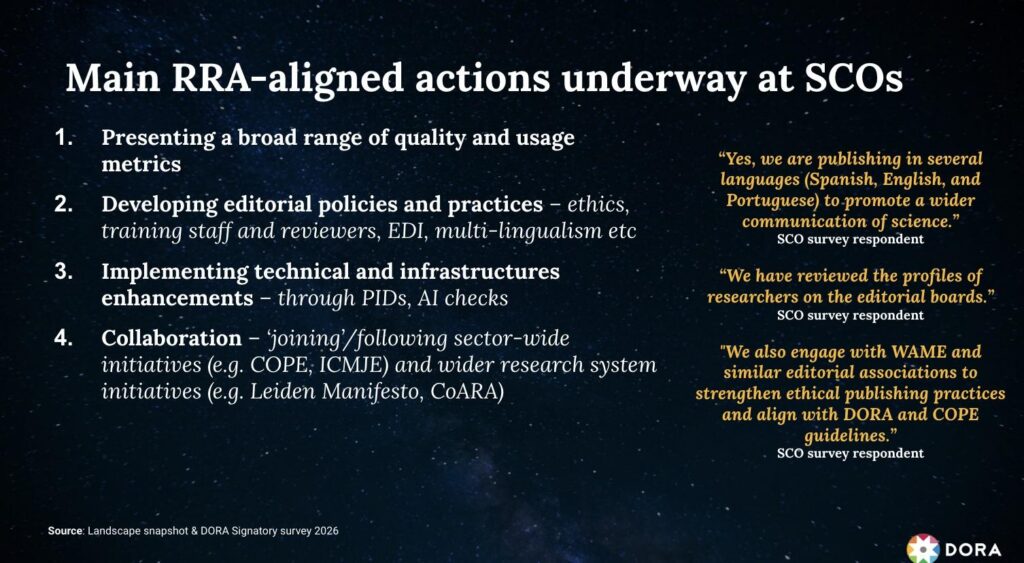
- Closing the Gap Between Publishers and Researchers: DORA’s landscape analysis and 2026 Signatory Survey revealed that while many scholarly communication organizations already support RRA, they often don’t recognize or communicate it—creating a disconnect with researchers seeking greater editorial diversity, multilingualism, and less reliance on Journal Impact Factors.
- Intervening Across Eight Scholarly Communication Workflows: Launching in May 2027, DORA’s third practical guide will target publishers, editors, preprint platforms, and librarians with actionable steps across eight workflow areas. These include diversifying editorial boards, recognizing peer review as a scholarly output, using operational and quality indicators with care, and highlighting null or negative findings.
Inside the Q&A: Navigating Assessment Realities and Next Steps
The session sparked a lively discussion across the Q&A and chat, with attendees and panelists digging into the practical realities of reforming research assessment:
- Balancing Qualitative Judgment and Quantitative Metrics: A lively Q&A exchange explored the tension between relying on metrics and trusting human judgment. While an attendee raised concerns that removing quantitative metrics could invite subjectivity, volatility, or favoritism, panelists noted that all peer review ultimately relies on human judgment—and that over-relying on narrow numerical indicators can encourage gamification rather than genuine scientific progress.
- Supporting Responsible Post-Publication Corrections: Attendees highlighted the need for clearer guidance on post-publication infrastructure. While much of the focus in scholarly communication centers on submission and peer review, participants noted a gap in helping researchers navigate responsible post-publication corrections—and ensuring that open PID infrastructure accurately captures and links those updates once an article is published.
- Digestible Summaries for Busy Teams: DORA confirmed that for each of its guides they include free, editable supplementary materials on Zenodo, such as 5–8 page briefs, single-page quick-reference sheets, and customizable slide decks.
- Sharing Practical Case Studies Across the Sector: Chat discussions emphasized the need for broader editorial board diversity, moving away from Journal Impact Factors, and sharing concrete examples so resource-constrained teams can adapt proven practices without starting from scratch.
- Co-Creating DORA’s Upcoming Guide: Giovanna and Liz invited the community to contribute real-world examples, gaps, and workflow case studies through the end of November to feature in DORA’s upcoming Scholarly Communication Guide ahead of its May release.
- Prioritizing Future ORCID Enhancements: ORCID invited attendees to share their thoughts on where ORCID should expand next to better support qualitative evaluation—such as enriching the biography section, adding context fields to other record areas, or improving service and membership affiliations.
How leaders, infrastructure teams, and publishers can turn these insights into action
Turning these insights into practice requires coordinated action across the research ecosystem:
- Institutional leaders and integrity officers: Audit internal assessment workflows to replace manual, free-text fields with trusted, PID-anchored data streams.
- Infrastructure leads and service providers: Strengthen integrations with ORCID and broader PID networks to automate data synchronization across repositories and CRIS systems.
- Publishers and editors: Adopt standard CRediT assertions and structured metadata so peer review and non-traditional contributions remain indexed, portable, and recognized.
Explore DORA’s existing Practical Guide to Implementing Responsible Research Assessment and stay tuned for DORA’s upcoming Scholarly Communication Guide launching in May.
Learn how becoming an ORCID member organization lets you write validated Trust Markers to researcher records—connect with our team to get started. Start automating your trusted data workflows today.