

Keynote by Leslie Chan, Department of Global Development Studies, Director of the Knowledge Equity Lab, University of Toronto. DORA Steering Committee, Past Board Member of DOAJ and IOI.
Leslie Chan’s keynote below, delivered at the 14th Global Research Council (GRC) Annual Meeting on May 20, 2026, in Bangkok, Thailand, underscored a critical shift in how we understand the relationship between Open Science and research assessment: openness alone is not enough unless incentives, evaluation practices, and governance are aligned with principles of equity, justice, and stewardship. Chan argued that Open Science must move beyond access to embrace an interconnected knowledge ecology in which who produces knowledge, who governs it, whose knowledge traditions are recognized, and who benefits from openness are central concerns. This includes meaningful engagement with Indigenous knowledge, local and community-based knowledge, and diverse epistemic traditions on their own terms. The keynote directly links Open Science to research assessment reform, since current metrics and reward systems often privilege dominant outputs, languages, institutions, and narrow definitions of excellence. To realize the full potential of Open Science, funders and institutions must contextualize excellence by embedding equity, multilingualism, stewardship, Indigenous data sovereignty, societal engagement, and diverse knowledge outputs into evaluation criteria.In this way, more equitable and plural approaches to research assessment become key enablers of Open Science, ensuring that openness advances not only visibility and efficiency, but also fairness, inclusion, and global knowledge equity. The keynote is based on the discussion paper intended to foster dialogue and exchange among GRC participating organizations in 2025–2026.
 Excellency, colleagues, friends, distinguished guests, and members of the GRC community,
Let me begin by thanking Thailand Science Research and Innovation, TSRI, and the Natural Sciences and Engineering Research Council of Canada, NSERC, for co-hosting this year’s Global Research Council conference. The venue and hospitality have simply been amazing!
 It’s an honour to present some aspects of the discussion paper I prepared for the GRC. The full text of the paper is available here for anyone interested in looking up the sources, fuller explanations of some of the terms and case studies that I will not have time to present.
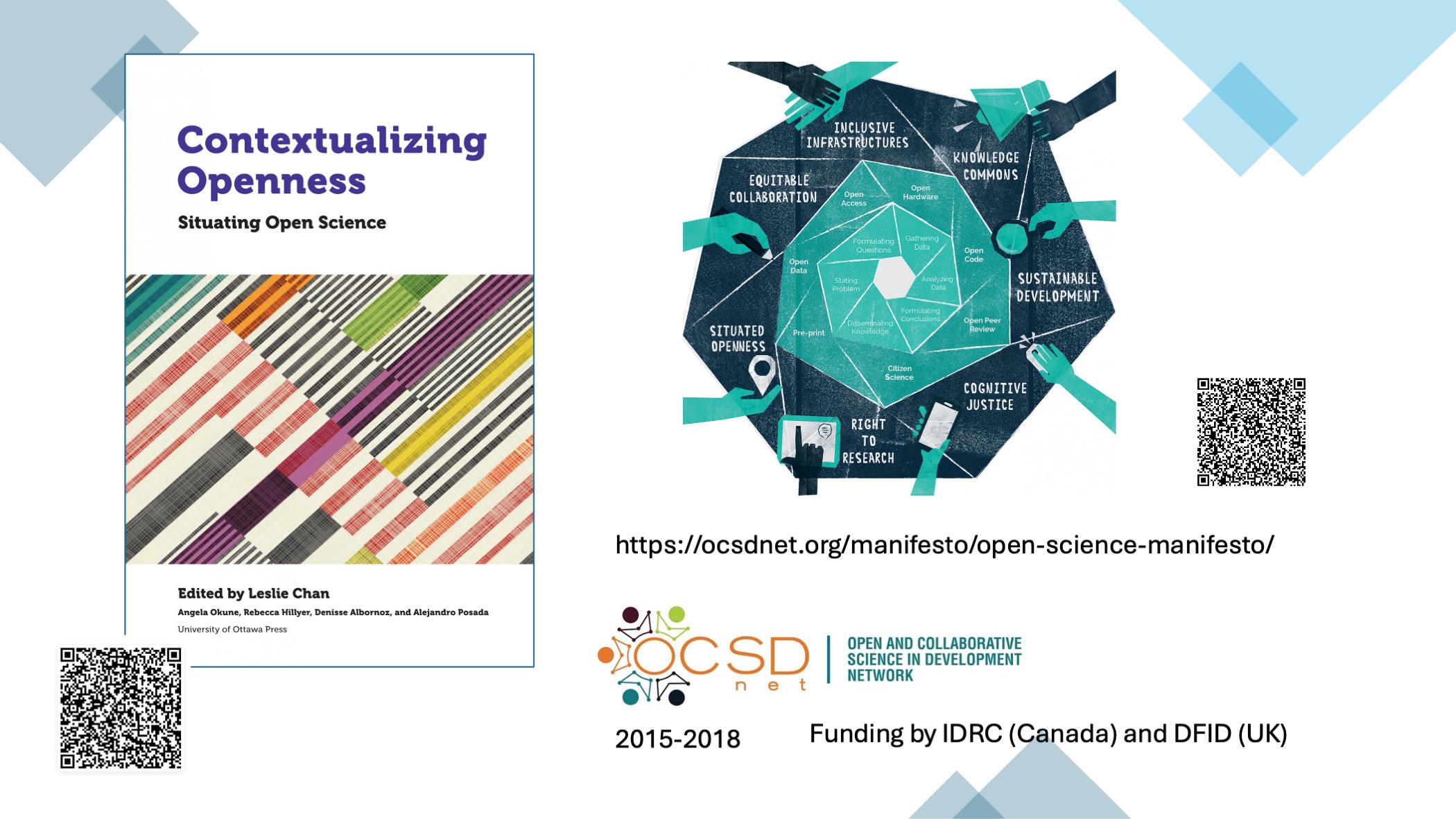 I should also mention that many of the lessons I draw on are based on a research network on open science in the global south funded by the IDRC of Canada a few years back. It’s also the IDRC that makes my presence here possible.
I would also like to thank Shaun Baron of NSERC for his guidance with the discussion paper and the GRC process. As I am not a funder and not familiar with the GRC, Shaun’s guidance has been invaluable.
We also discovered last evening at the reception extravaganza that Shaun is quite a dancer!
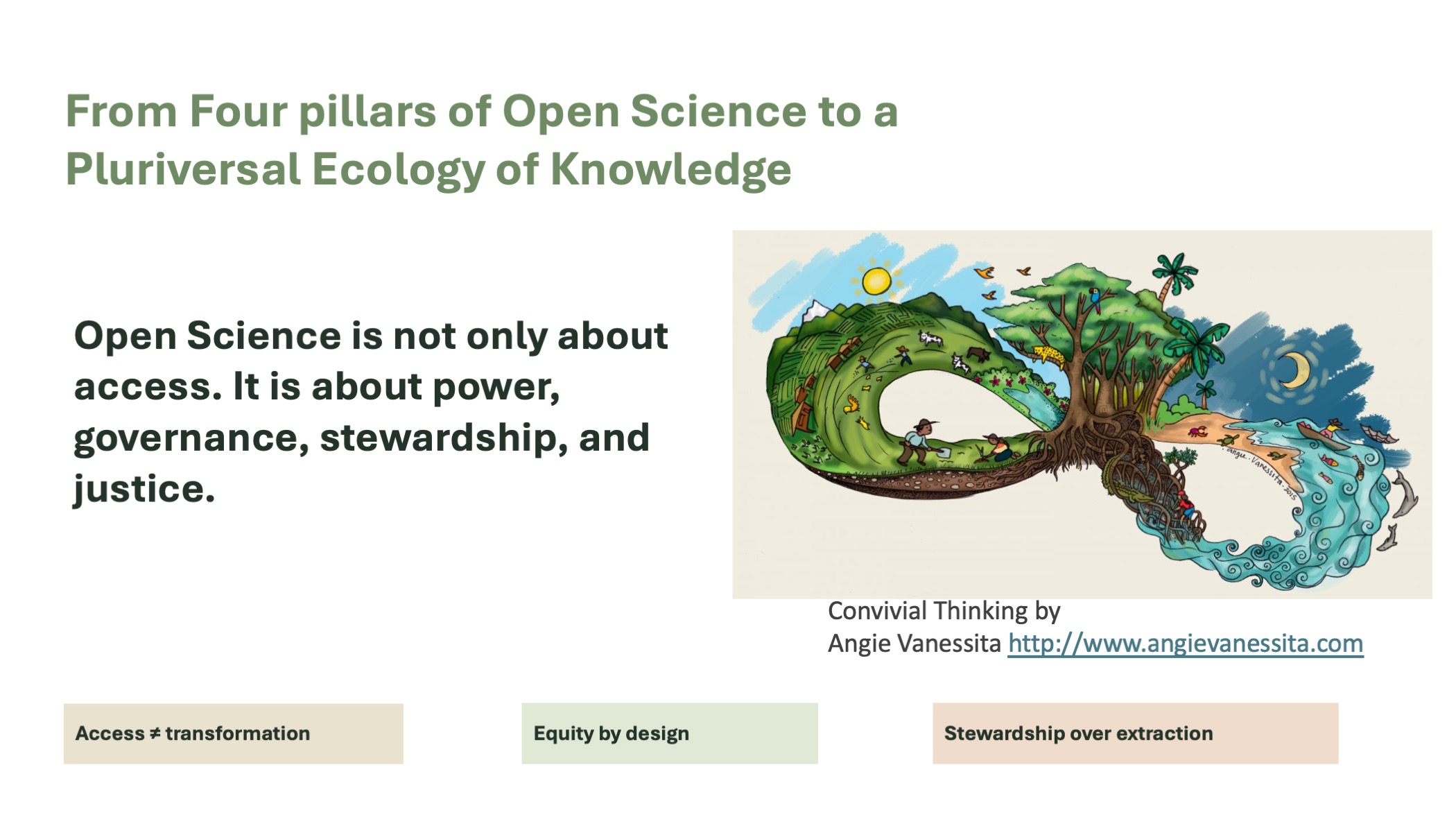 My overall message is direct; if Open Science is to fulfill its promises of addressing global challenges, foremost of which is persistent inequality and resilient communities, we need to first ensure that Open Science is built on an equitable foundation.
The GRC process is meaningful because it reminds us that Open Science cannot be advanced from a single national, regional, or institutional perspective. Consensus must be built through dialogue across different histories, capacities, knowledge traditions, and development priorities.
Speaking from Canada, I recognize the contributions Canadian funders have made to open access, research collaboration, knowledge equity, community infrastructure, and more plural approaches to research assessment.
But openness, by itself, is not enough. In Canada, we have learned — and are still learning — that knowledge cannot be separated from colonial history, governance, consent, place, memory, relationship, and community control.
Principles such as the First Nations principles of OCAP and the Global Indigenous Data Alliance’s CARE Principles remind us that making knowledge open is not the same as making knowledge just.
 The Statement of Principles to be endorsed later today marks an important moment for the GRC. It recognizes that Open Science has moved beyond access alone to ask harder questions: whose knowledge counts, who sets research agendas, who is resourced, and who benefits from openness?
The UNESCO Recommendation on Open Science gives us four widely referenced pillars: open scientific knowledge, open infrastructures, open engagement of societal actors, and open dialogue with other knowledge systems.
But implementation has been highly uneven. Global efforts have focused mainly on the first two pillars: publications, data, repositories, platforms, and interoperability.
Pillars three and four — engagement with societal actors and dialogue with other knowledge systems — have lagged because they require deeper structural changes in governance, institutional culture, incentives, and research practice.
This unevenness matters because Open Science is still often presented as a technical project: open publications, share data, build repositories, improve machine interoperability, and the benefits will follow.
 These practices matter. But we have learned that access without equity can entrench unequal systems.
Access without co-governance can reproduce extraction.
Access without attention to language, culture, infrastructure, history, and power can widen the inequities Open Science is meant to redress.
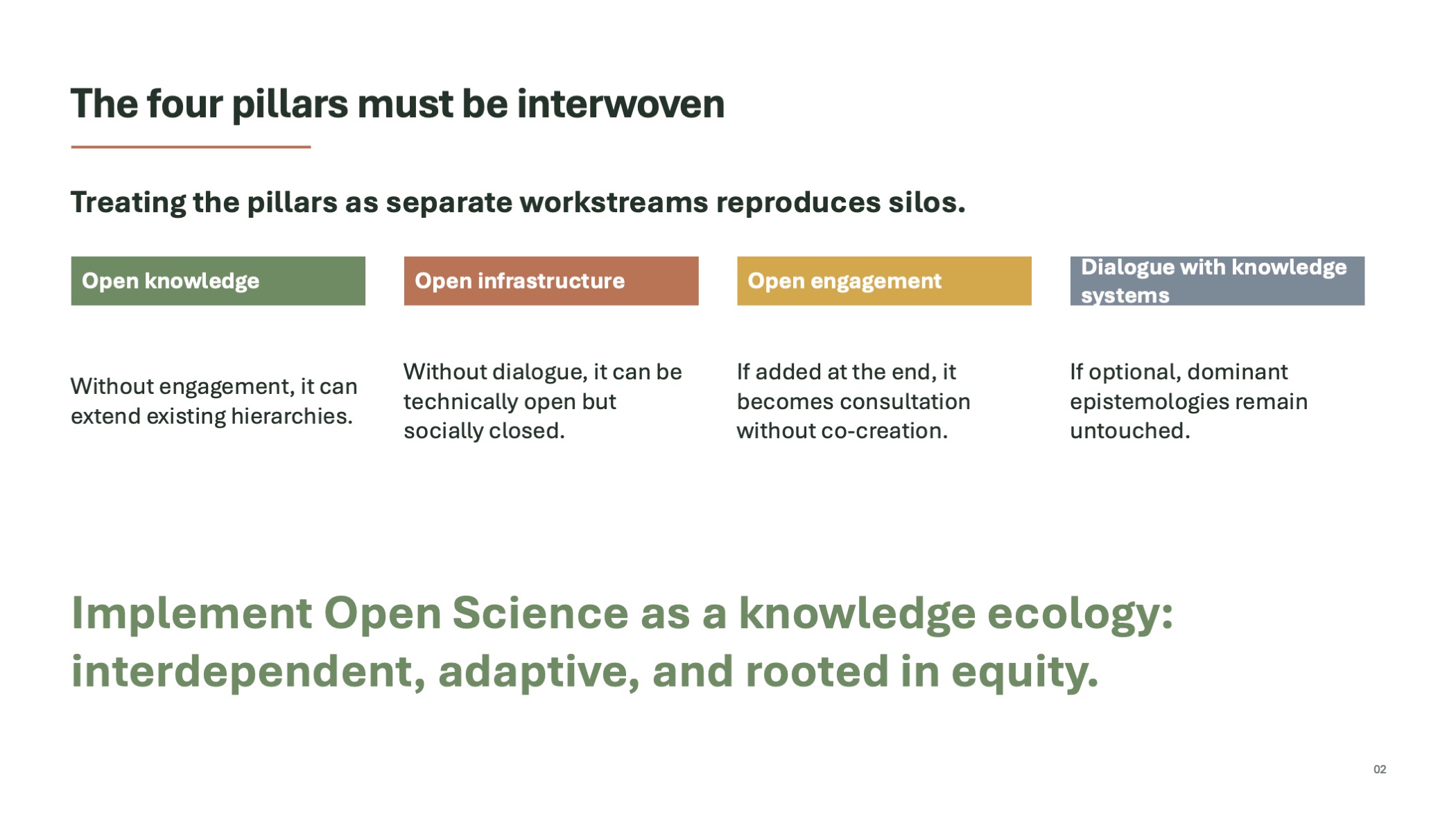
My key message is that the four pillars should not be treated as separate workstreams.
They are better understood as an interconnected knowledge ecology.
Equity, diversity, inclusion, and epistemic justice are not add-ons to that ecology. They are the architecture of stewardship and care that makes Open Science possible.
This has practical implications.
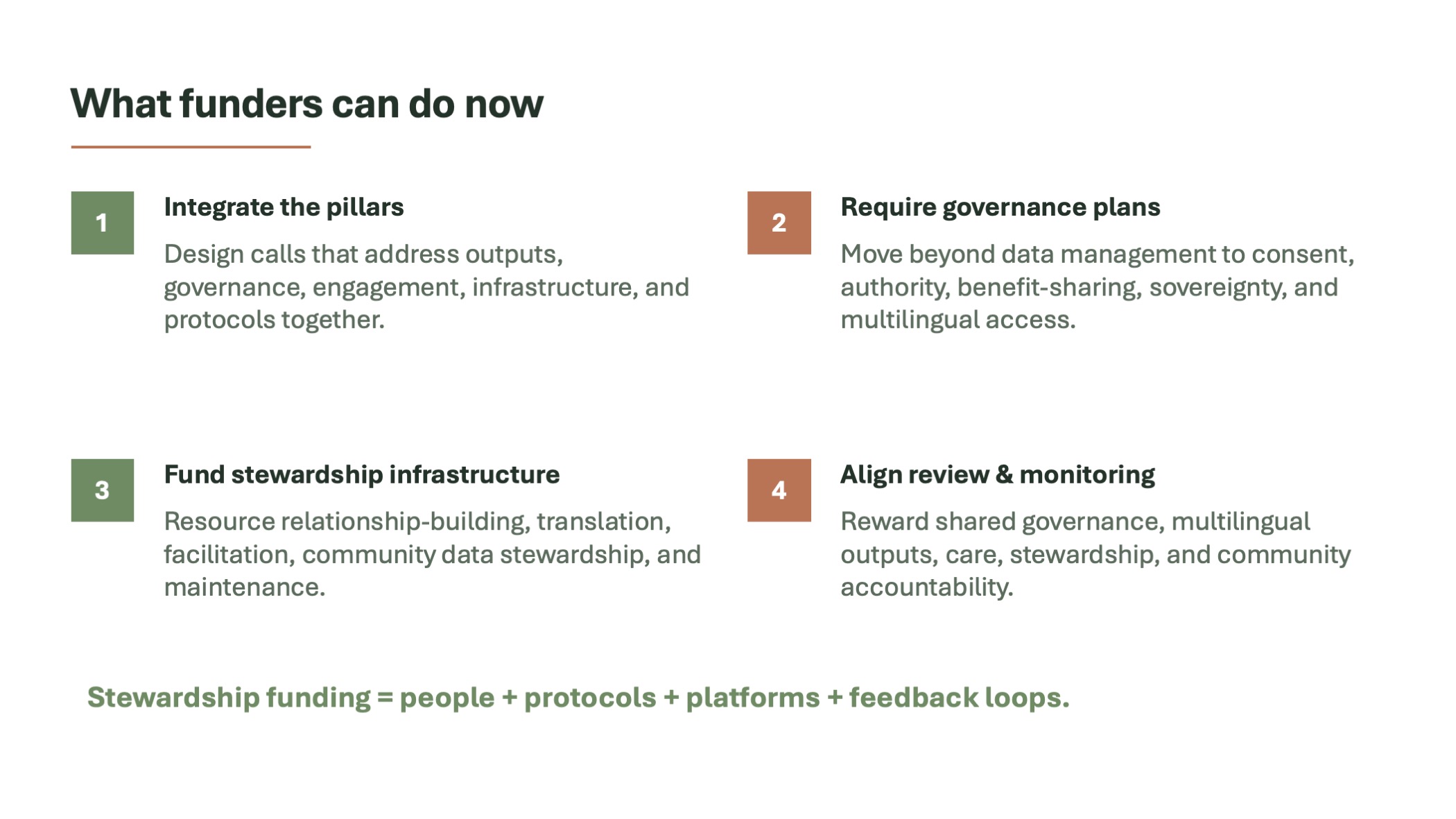
Funding calls should address the four pillars together: how outputs are shared, who governs the knowledge, who benefits, what infrastructures are used, what engagement is built in, and how Indigenous, local, or community protocols are respected.
Funders should require equity and knowledge-governance plans, not only data-management plans, addressing consent, community authority, benefit-sharing, data sovereignty, multilingual access, and the possibility that some knowledge should not be shared openly at all.
Funders should also resource the infrastructure of stewardship and care: relationship-building, translation, community facilitation, Indigenous and local data stewardship, long-term maintenance, and knowledge mobilization beyond academic audiences.
This includes community-governed, non-commercial infrastructure. Diamond Open Access is an important example. Long before the term became globally visible, Latin American initiatives such as SciELO, Redalyc, and La Referencia showed that scholarly communication can be public, regional, multilingual, and not dependent on charging readers or authors.
Funders should strengthen these accomplishments, as the recent Bengaluru’s Road Map on Diamond OA also emphasizes, and not import models built around commercial platforms or article processing charges.
Review, assessment, and monitoring should align with these values of public goods.
Peer review should reward care, stewardship, shared governance, multilingual knowledge, and community accountability.
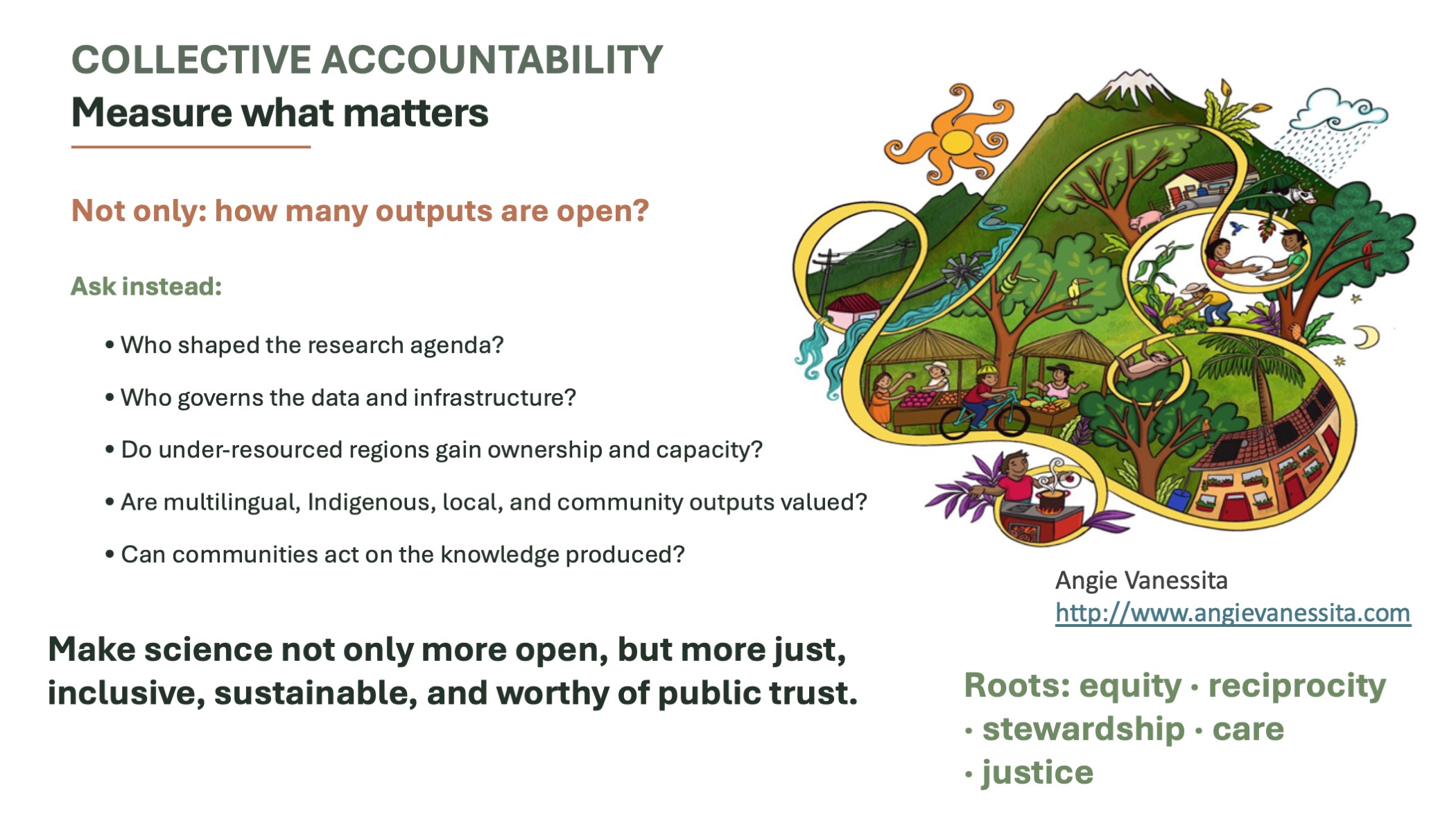
Monitoring should ask who shaped the agenda, who governs the data, whether under-resourced regions gain ownership and capacity, and whether communities can act on the knowledge produced with their input.
These actions move Open Science from principle to practice. They also show why the pillars are streams that intertwine.
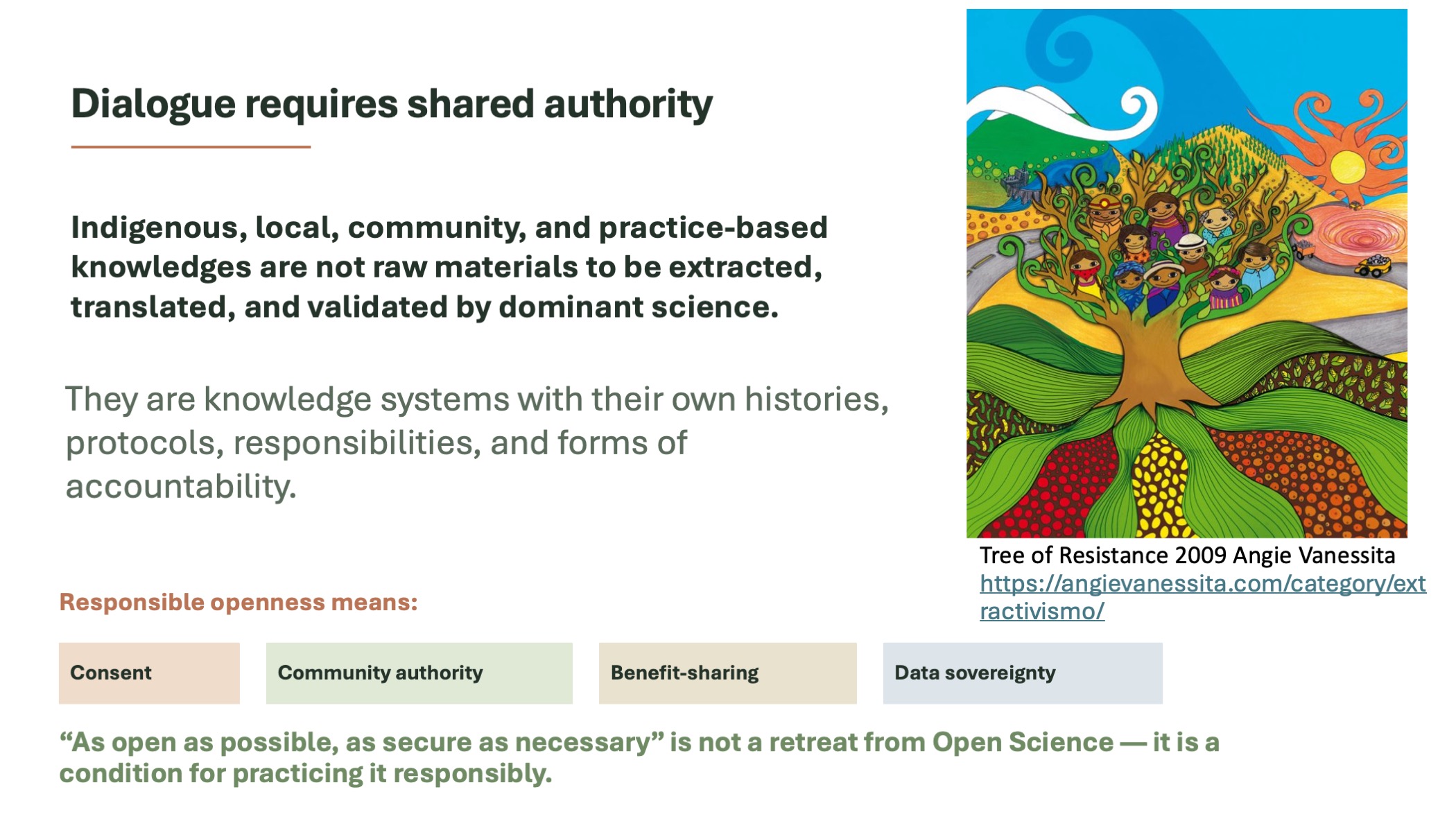 And if dialogue with Indigenous, local, and practice-based knowledge systems is seen as optional, Open Science will continue to privilege dominant institutions, languages, metrics, and epistemologies.
So dialogue with other knowledge systems is not a nice-to-have. It is what allows Open Science to know its own limits as well as its potential.
It is not simply about inviting more voices into a pre-existing structure. It requires us to ask who builds the space, who sets the terms, and whether the structure itself needs to change.
Indigenous, local, community, and practice-based knowledge are not raw materials to be extracted, translated, and validated by dominant science. They are knowledge systems with their own histories, protocols, responsibilities, and forms of accountability.
But respectful dialogue is also a matter of institutional design.
Inclusion can still leave power untouched. Communities and knowledge holders may be invited into advisory roles while decision-making authority remains with those who control the agenda, budget, data, infrastructure, and interpretation of results.
Open dialogue requires shared authority and co-governance, including the possibility that communities may define openness in their own contexts.
In some contexts, not sharing data widely may be the more ethical choice.
“As open as possible, as secure as necessary” is not a retreat from Open Science; it is a condition for practicing it responsibly.
This is why equity and epistemic justice should be built into Open Science policy and infrastructure from the beginning.
Equity should inform funding rules, eligibility criteria, assessment practices, data governance, infrastructure investments, partnership models, monitoring systems, and even the definition of excellence itself.
Infrastructure is not only repositories, platforms, standards, and metadata. Infrastructure is also the relationships, capacities, protocols, and trust that make knowledge sharing meaningful, safe, and accountable. Stewardship with care is infrastructure.
 No single funder or community can transform Open Science alone. But funders and research entities collectively can shape incentives, infrastructures, assessment cultures, and international norms.
This gives the GRC a special responsibility: value alignment without policy cloning, and coordination across differences strong enough to prevent injustice but flexible enough to respect regional histories, languages, epistemologies, capacities, and priorities.
Research assessment reform is crucial to this collective work.
Many barriers have already been identified by GRC working groups, DORA, and other reform efforts. The question now is coordinated action: aligning funding criteria, peer review, institutional incentives, and monitoring systems so that stewardship, openness, collaboration, multilingualism, community engagement, and diverse knowledge outputs are recognized as core contributions to research excellence.
Let me close by returning to the four pillars.
Pillars suggest separate structures. But Open Science is not a temple built from four independent columns. It is more like a living knowledge ecology. Publications, data, infrastructure, communities, languages, protocols, metrics, institutions, histories, and above all people, are intertwined. The health of the canopy depends on the health of the roots.
And the roots are equity, trust, reciprocity, stewardship, care, and justice.
I would like to applaud members of the GRC for not only making science more open but also honouring the commitment to make science more just, more inclusive, more sustainable, and more worthy of public trust.
Thank you!