
DORA is delighted to announce the launch of its Introduction to Responsible Research Assessment Course. This online, self-paced course provides an approachable, entry-level curriculum for anyone at any career stage and in a variety of roles to learn about responsible research assessment (RRA). The course is free for individuals to take but it requires registration, and provides the option of issuing a certificate for each of its four lessons and one for its full content.
Why this Course?
Traditional methods of research assessment, such as a reliance on single metrics to assess research and researchers, remain embedded in academic systems worldwide. Despite decades of evidence that these traditional methods neither recognize nor reward the diverse outputs of research nor the rich contributions of researchers, these systems have proved remarkably intransigent to change and modernization. Further, across different regions and contexts, even the term “research assessment” can have varied meanings.
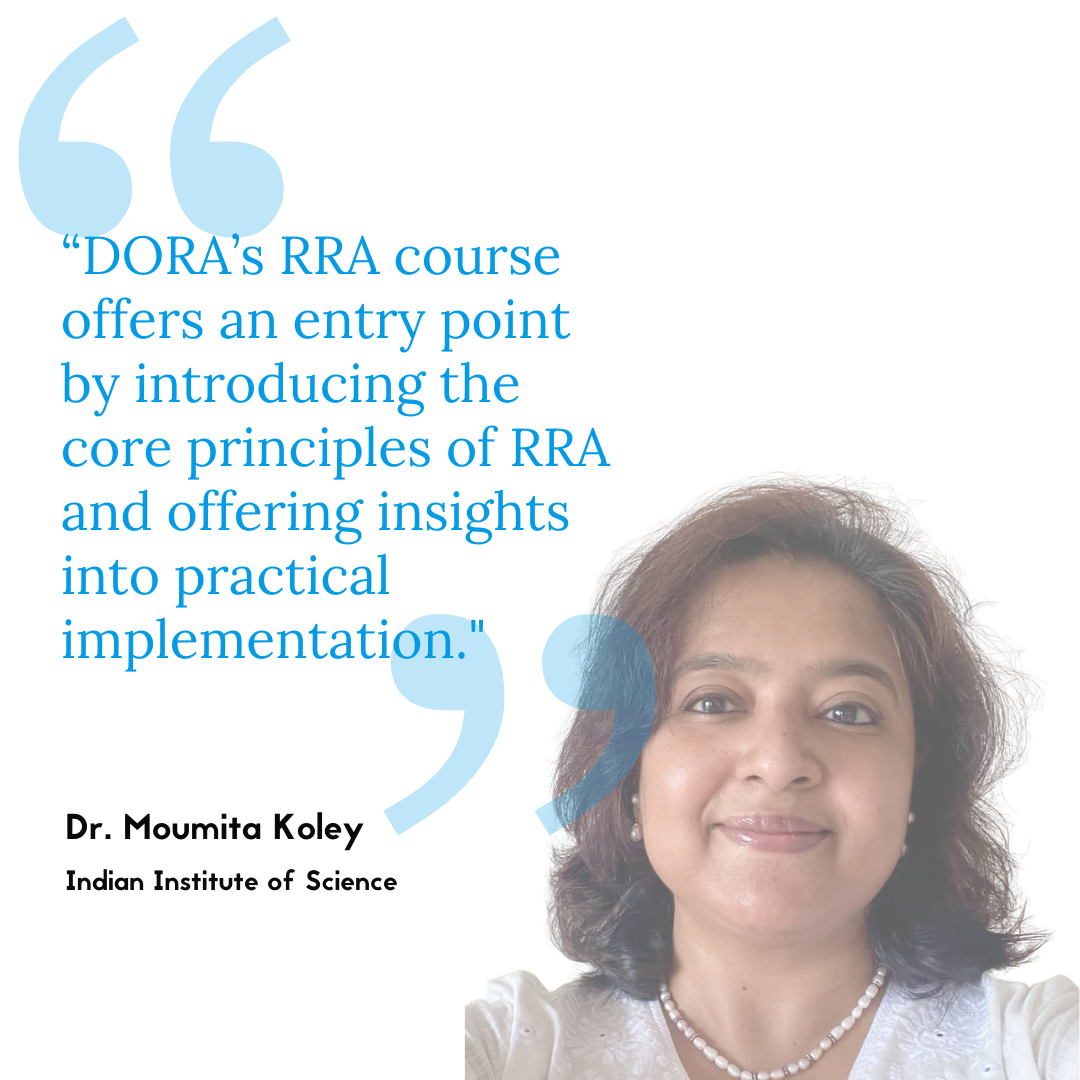
Compounding this problem, there is a paucity of resources on RRA that provide, specific, concrete training that is targeted at people who are new to rethinking traditional assessment practices and which connects RRA to other initiatives, such as transparency and integrity. Moumita Koley, Indian Institute of Science and DORA Steering Committee member, expands on this:
The Responsible Research Assessment (RRA) agenda is gaining real momentum among researchers, research managers, and policymakers worldwide. There is growing recognition that decades of metric‑driven evaluation, often centred on journal impact factors and crude citation counts, have distorted priorities, incentives, and behaviours in research systems. Yet awareness of the problem is only a first step. The urgent question is how to build credible, workable alternatives that can actually replace these entrenched practices in hiring, promotion, and funding. DORA’s RRA course offers an entry point by introducing the core principles of RRA and offering insights into practical implementation.
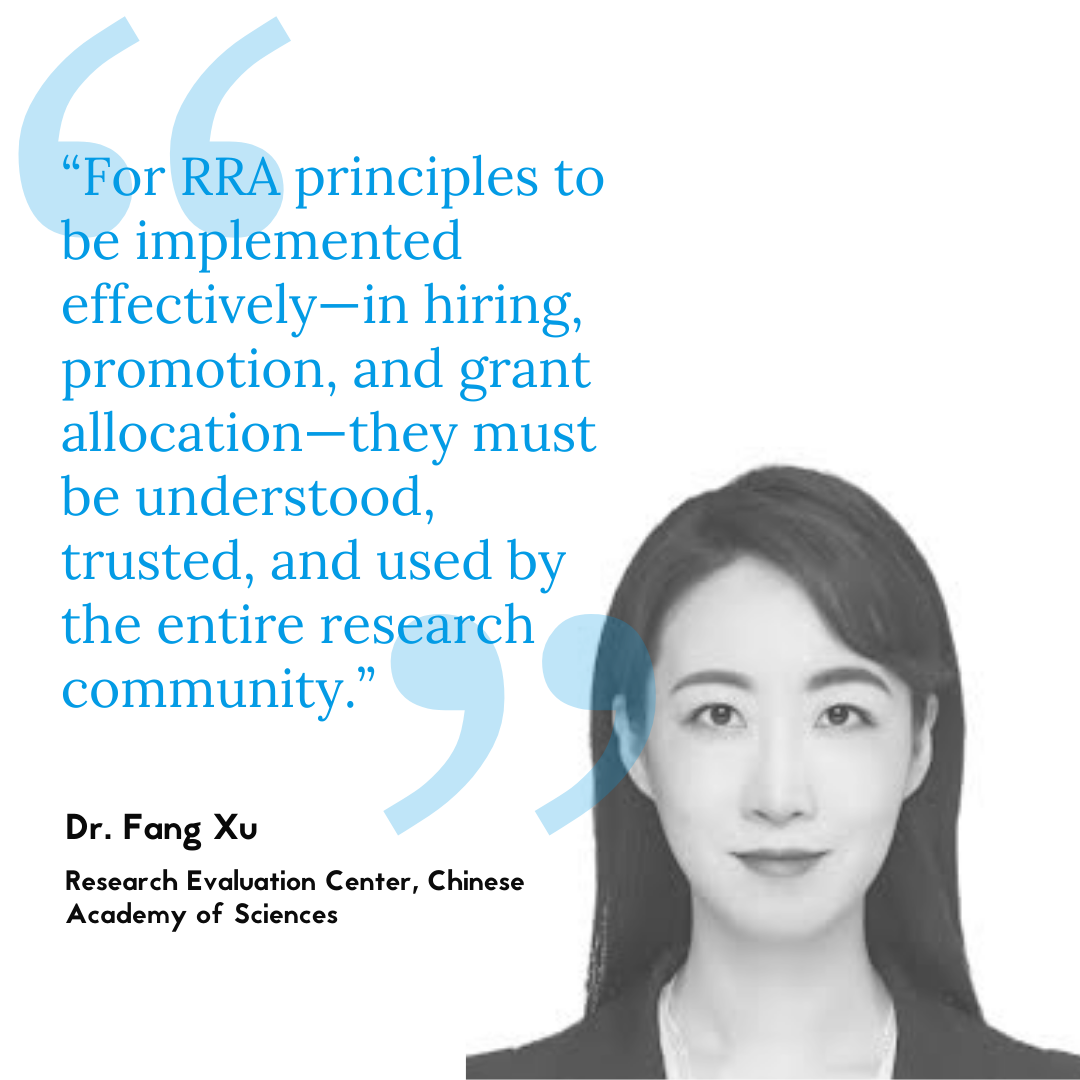
This new course deliberately takes an introductory approach to inform those engaged with research assessment and empower more people to improve it. Fang Xu, of the Chinese Academy of Sciences and DORA Steering Committee, elaborates:
Broadening participation in the RRA conversation is a critical step for ensuring its practical success. Current discussions are often dominated by senior academics and policy experts, which is necessary but insufficient. For RRA principles to be implemented effectively—in hiring, promotion, and grant allocation—they must be understood, trusted, and used by the entire research community. This includes early career researchers, who face the greatest pressure from conventional metrics; professional staff in research management and administration, who operationalize assessment procedures; and scholars from a wider range of institutions and geographic regions. Without their direct input, there is a real risk that RRA will be perceived as abstract or irrelevant, or might unintentionally replicate old biases in new forms. Therefore, expanding who is at the table is not just about inclusivity; it is fundamentally about building systems that are robust, practicable, and legitimate for all those they are intended to serve.
DORA Introductory Course At a Glance
This introductory course is open to everyone, regardless of career level or discipline, who is interested in understanding the basics of research assessment. It is specifically designed for those who have a basic familiarity with academia, but who are unfamiliar with research assessment practices and/or responsible research assessment. This includes researchers, technicians, librarians, grant advisors, policy officers, and the breadth of roles working in research performing organizations, funding organizations, publishers, journals, academic societies, among others in the academic system.
The course is designed to provide a foundational understanding of reform through four short lessons:
- Lesson 1: What is responsible research assessment? This lesson defines the core purpose and scope of responsible research assessment as a shift toward more holistic, qualitative evaluation.
- Lesson 2: Responsible research assessment impacts everyone. This lesson explores how assessment influences the entire academic ecosystem and describes global initiatives driving change.
- Lesson 3: Limitations of traditional assessment approaches and quantitative indicators. This lesson critically analyzes commonly misused metrics and introduces five guiding principles for responsible indicator use: be clear, transparent, specific, contextual, and fair.
- Lesson 4: How can responsible research assessment be applied to real-world assessment scenarios. This lesson provides examples of practical innovations, such as the use of Narrative CVs and bias-mitigating review panels.
The course focuses on introducing key concepts, definitions, and shared understandings needed to engage meaningfully with research assessment reform. The lessons establish a common vocabulary and conceptual grounding, helping learners understand not only what RRA is, but also why it is needed. Each lesson includes a suggested reading list, real-world case study examples, knowledge-testing quizzes, and reflective questions. Learners have the option to take a final quiz at the end of each lesson to receive a certificate of achievement. They also have the option to take a quiz to receive a certificate of achievement for the entire course.
Yes, you can take the course whenever it suits you. Each lesson is designed to take about 20-30 minutes, but there is no time limit. You can stop and restart at any point. When you register for the course, you’ll be able to mark each topic as complete as you progress, making it easy to keep track of what you’ve already covered. You can learn more about how to navigate the course by reviewing a short PDF file here or watching a short video here.
Optional automatic translations are available, powered by Google Translate. Translations are therefore not perfect, since this is a free translation service that provides instant translations between different languages to increase accessibility. As such, not all text may be translated or translated accurately from our English version website. We appreciate your understanding of its limitations.
Yes, individuals may use the course to support their education efforts. Each lesson is accompanied by a Teaching Support Guide and a slide deck to help you easily incorporate key course concepts into seminars, workshops, graduate ethics classes, faculty orientations, and so on. If you would like to customize or brand this course for your own use within your organization, please contact us at info@sfdora.org to discuss further.
Fulfilling DORA’s Strategic Plan
The launch of this course is a direct realization of DORA’s 2023-2026 Strategic Plan, which focuses on moving beyond a declaration of recommendations toward active global reform. The course specifically fulfills the following elements of DORA’s strategic objectives:
- Objective 1: Increasing awareness of the negative impacts of inappropriate metrics and the positive potential of alternative practices.
- Objective 2: Accelerating the development of clear and concrete measures to reform research assessment through the creation of training materials on best practices and innovations in research assessment.
- Objective 3: Supporting advocates worldwide by equipping them with free tools and a common vocabulary to drive institutional change.
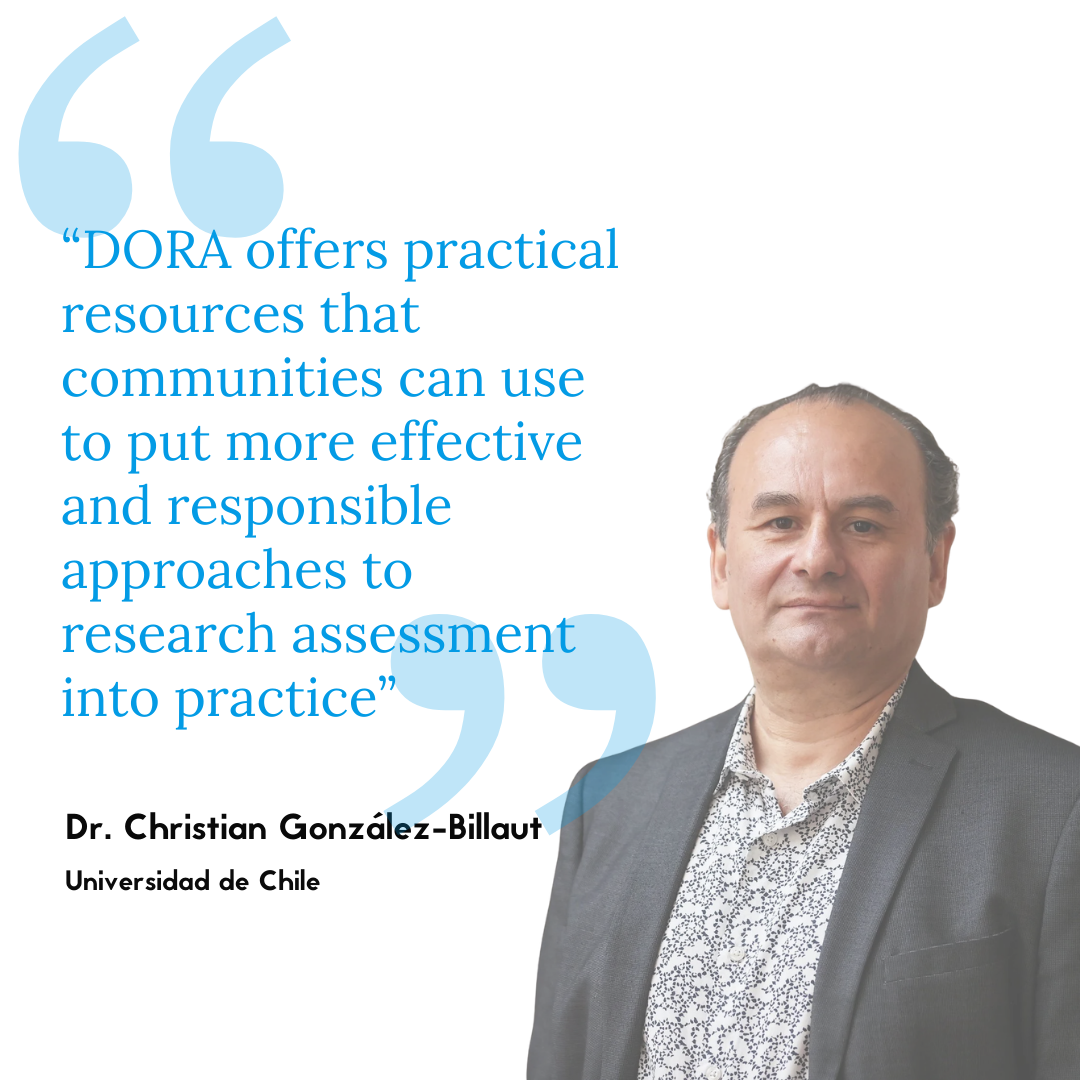
“We believe that RRA is a collaborative effort. However, it is not always easy to know where, when, or how to begin. To support this process, DORA offers practical resources that communities can use to put more effective and responsible approaches to research assessment into practice, and actively advocates for the widespread implementation of RRA across research systems.” says Christian Gonzalez-Billaut, Universidad de Chile and DORA Steering Committee.
By offering this course, DORA aims to provide the global research community with the resources and foundational knowledge needed to foster a fairer and more impactful research environment. We look forward to receiving your feedback and continuing to develop it with all in the community! Please use the feedback forms available across the lessons and/or email us at info@sfdora.org.
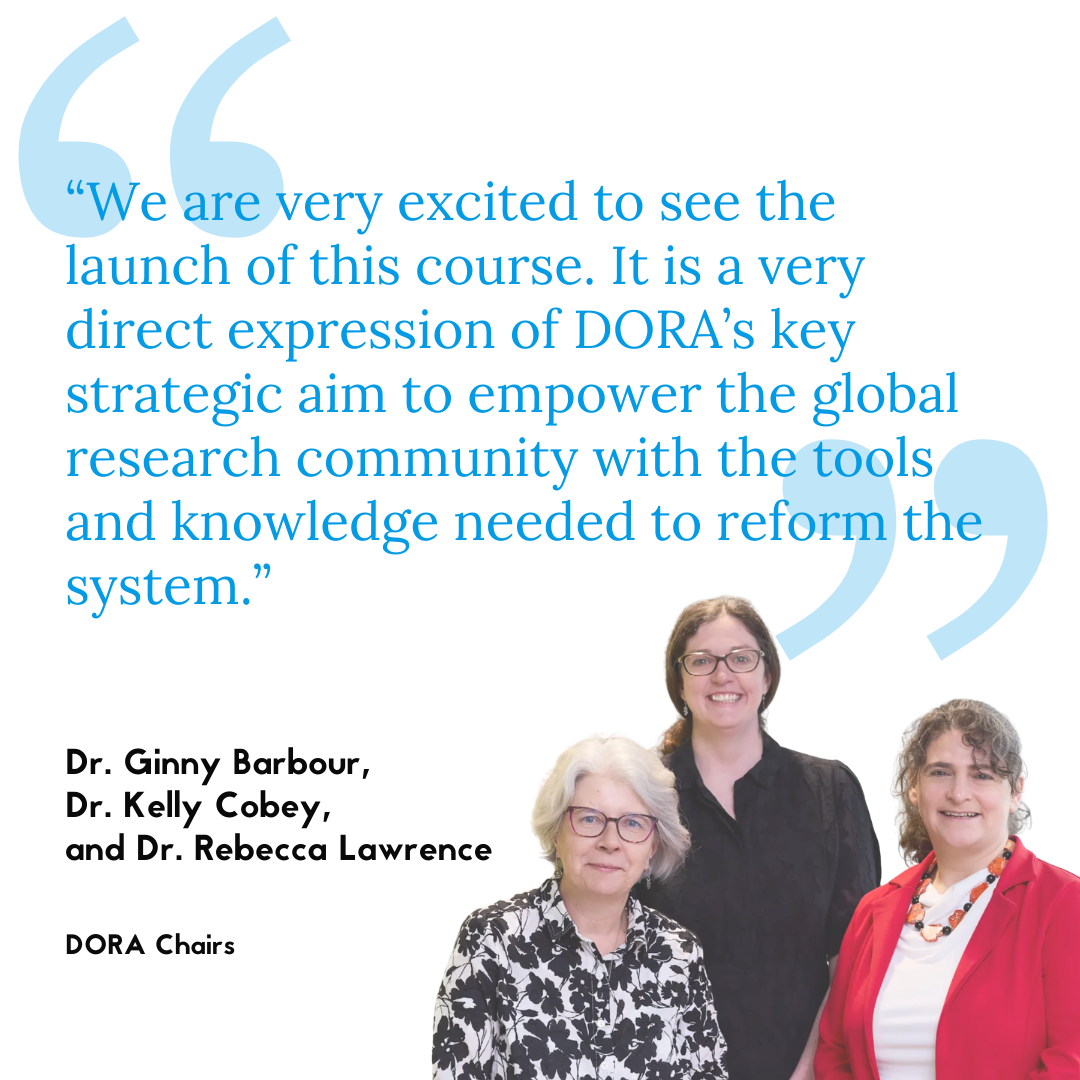
Ginny Barbour, Kelly Cobey, and Rebecca Lawrence, DORA Chairs, expand on the vision for this course:
As DORA Chairs, we are very excited to see the launch of this course. It is a very direct expression of DORA’s key strategic aim to empower the global research community with the tools and knowledge needed to reform the system. Its development was informed by, and is reflective of, this global community and we hope that by engaging with the course, it will help inspire and develop the next generation of advocates and their concrete reform of research assessment.
The Course was developed by Project Coordinator Haley Hazlett, in collaboration with Program Manager Giovanna Lima and the DORA working group composed of Steering Committee members: Ginny Barbour, Christian González-Billault, Kelly Cobey, Anna Hatch, Moumita Koley, Stuart Lane, Rebecca Lawrence, Bernd Pulverer, Sean Sapcariu, and Fang Xu. We are grateful to each of them, as well as to the many colleagues around the world who helped pilot the course and enrich it with their insights.