


Society and universities value societal impact. Funders encourage open science. Publishers ask for transparency. Everyone wants trustworthy research. To many, it can feel like every year brings a new priority. But these aren’t separate conversations. They are different parts of the same conversation about what research systems value and reward. Assessment is not a separate reform agenda. It is one of the mechanisms through which research systems define and reward success. The goal is not better assessment for its own sake: the goal is a research system that is more open, more inclusive, more trustworthy, and better able to contribute to society. Progress happens through interconnected changes that reinforce one another.
The scholarly research and publishing system is a global, interconnected system: every part of it influences, and is influenced by, each other part. Responsible research assessment (RRA) is inseparable from the wider system of values, practices, and change movements that shape research culture. In this blog post, we briefly explore the connections between research assessment and the key components of the research system. These relationships are examined in greater detail in Chapter 4 of our latest Practical Guide for Research Funding Organizations, developed in collaboration with the Global Research Council RRA Working Group and Science Europe.
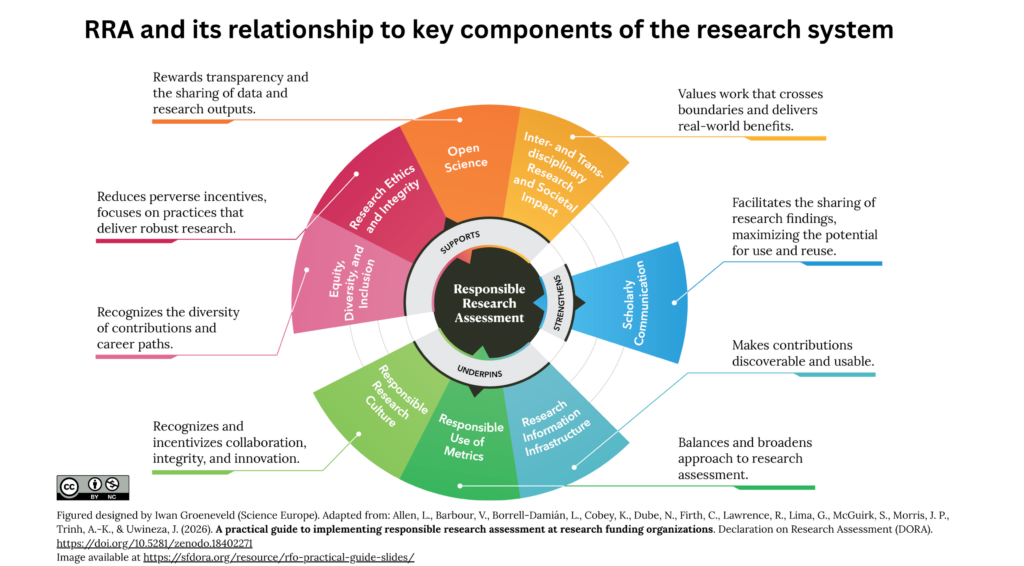
How responsible research assessment interconnects with key components of the research system
RRA is underpinned by and in turn helps to shape three foundational elements of the research system: Responsible Research Culture, the Responsible Use of Metrics, and a robust Research Information Infrastructure. Research cultures affect whether reviewers and institutions feel comfortable making holistic judgements; responsible metrics provide contextual information that supports evaluation without reducing it to a single number; and research information infrastructures determine which contributions are visible, discoverable, and connected across the system. Without these foundations, even well-designed assessment reforms can struggle to gain traction.
At the same time, assessment helps shape each of these foundations. What organizations choose to recognize and reward influences research culture, signalling whether collaboration, mentoring, openness, and integrity are valued alongside publications and grants. Assessment practices also influence how metrics are used: indicators can either become shortcuts that stand in for quality, or contextual evidence that supports expert judgement. Likewise, as assessment expands beyond traditional publications to include mentoring, peer review, research protocols, and other contributions, it creates demand for more inclusive and interoperable information systems capable of capturing the full range of research activities.
Building on this foundation, RRA directly supports and is supported by key systemic change movements: Equity, Diversity, and Inclusion; Research Ethics and Integrity; Open Science; and Inter- and Transdisciplinary Research and Societal Impact. Each challenges narrow definitions of quality and success, and calls for assessment systems that can recognize a broader range of contributions, pathways, and forms of excellence.
Assessment plays an important role in enabling progress across these areas. Open science practices require substantial investments of time and effort in activities such as sharing data, software, protocols, and other outputs. Community-engaged and interdisciplinary research often develops through long-term relationships and produces outcomes that cannot be easily captured by publication counts alone. Similarly, mentorship, team science, research leadership, and activities that support inclusion and belonging are essential to healthy research environments but have often received limited recognition. When assessment systems acknowledge these contributions, they create the conditions for researchers and institutions to invest more confidently in them.
The relationship also works in the opposite direction. Efforts to improve openness, integrity, inclusion, and societal engagement broaden our understanding of what high-quality research looks like and challenge assessment systems to evolve. They expose the limitations of narrow metrics, linear career assumptions, and traditional notions of academic impact. As these movements gain momentum, they help create a stronger foundation for responsible assessment, while responsible assessment helps embed their goals into everyday research practice. This mutual support loop means that RRA mitigates the systemic prestige and linear-career biases that historically lock out minoritized groups, provides the recognition required for researchers to engage in often time-consuming open practices, and creates the flexible evaluative space needed to recognize diverse outputs and long-term pathways to impact generated through transdisciplinary and community-engaged research.
Scholarly Communication plays a distinctive, bridging role. Research assessment depends on research outputs being visible, discoverable, and understandable, and scholarly communication provides the mechanisms through which this happens. Innovations in publishing, including open access, preprints, multilingual dissemination, open review, and new forms of research outputs, expand the range of contributions that can be visible, accessible, and therefore assessable.
At the same time, the success of these innovations depends heavily on assessment. Researchers make decisions about where and how they communicate their work within the realities of hiring, promotion, funding, and recognition processes. If assessment systems continue to reward only a narrow set of publication venues or output types, many promising innovations in scholarly communication will remain difficult for researchers to adopt. Assessment therefore influences whether new communication models gain more traction.
Aligning our priorities with the research we want and need
Most researchers and institutions are driven not by publication counts but by curiosity and a desire to help address complex societal challenges. Digital scholarship and artificial intelligence are expanding the scale and speed at which research can be conducted, connected and shared, while making open, collaborative, rigorous and community-engaged practice increasingly central to what good research looks like. Yet many assessment systems still place emphasis on a much narrower set of contributions and ways of doing research.
When it comes to crucial moments like hiring, promotion, and funding, researchers are forced to navigate a painful dissonance. These assessment moments often continue to reward publication volume, citation counts, and publication venue prestige above many of the activities and contributions that make research more open, trustworthy, collaborative, and relevant. This mismatch creates a fundamental challenge for modern science. The same is true for other moments of assessment, including funding proposals and national assessment systems: researchers and institutions are encouraged to pursue a diverse and inclusive vision of excellence, while assessment systems often reward another. That is why DORA’s mission is to advance practical and robust approaches to improve the assessment of research across all scholarly disciplines worldwide.
The call is for aligning assessment approaches to the priorities of the research we want and need. When the pressure to publish volume is removed, researchers can focus on meticulous, reproducible work rather than rushing to print. If we reward researchers for sharing their protocols and data openly, other scientists can replicate and build on their work. A fairer assessment system recognizes that talent comes in many forms, including those who adopt engaged scholarship and work directly with local communities, patients, and policymakers. These are just a few of the potential benefits that reforming research assessment can bring.
Whether you are a senior policymaker, a university manager, a funder, a researcher, a publisher, or a curious member of the public, we all have a role to play in shaping a better research future. What change are you trying to create, and how can research assessment help accelerate it?