

Each quarter, DORA holds a Community of Practice (CoP) meeting for National and International Initiatives working to address responsible research assessment reform. This CoP is a space for initiatives to learn from each other, make connections with like-minded organizations, and collaborate on projects or topics of common interest. Meeting agendas are shaped by participants. If you lead an initiative, coalition, or organization working to improve research assessment and are interested in joining the group, please find more information here.
During the DORA National and International Initiatives Discussion Group meeting on March 10, 2026, members of the group gathered to explore the crucial intersection between scholarly publishing reform and research assessment reform. We heard a presentation from Katie Corker (Executive Director, ASAPbio) and Felix Dijkstal (Science Officer, International Science Council) who shared outcomes and next steps stemming from a joint workshop held in Pisa in November 2025, convened by DORA, ASAPbio, CWTS, and the ISC.
Navigating the Complexities of Reform
A central premise of their presentation was that reforming scholarly publishing and research assessment are deeply interdependent; progress in one movement relies heavily on success in the other. Corker and Dijkstal noted that over-reliance on the Journal Impact Factor (JIF) and H-index has distorted research culture, and that traditional publishing models limit who can participate in and consume research. They outlined the shared challenges that both movements must collaboratively address: the limitations of journal prestige, the outsized influence of selective bibliographic databases, the need for recognition of peer review, and the under-recognition of research outputs beyond traditional articles.
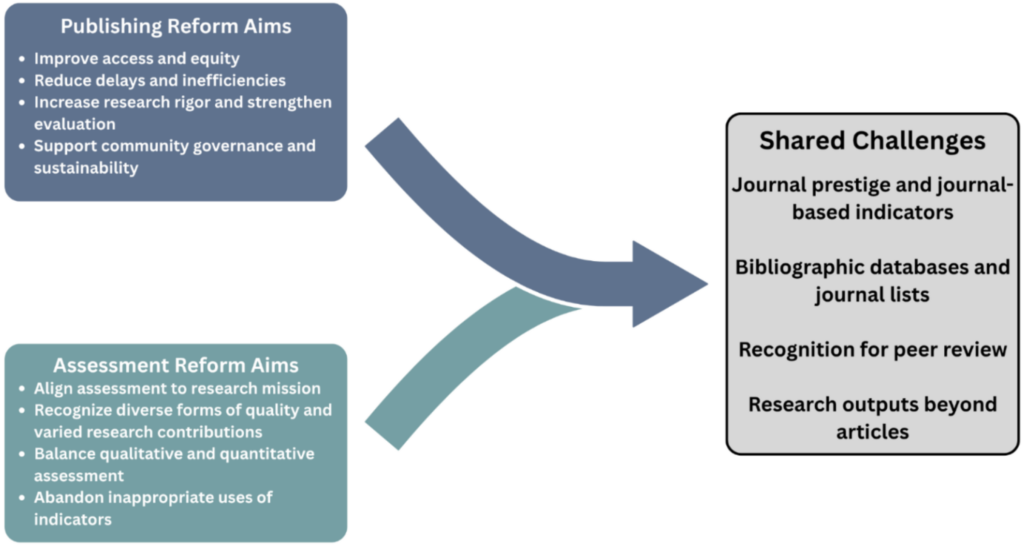
To address these shared challenges without duplicating existing initiatives, the group has mapped out three coordinated action areas, for which action groups are being formed:
- Beyond the Article: This initiative aims to elevate the status of non-traditional research outputs-such as data, code, policy reports, and public outreach-so they are valued contributions in research assessment. A key focus is building consensus on norms and strengthening coordination across the ecosystem.
- Trust Indicators: Currently, there is no standardized framework for signaling the trust of different types of research content. The goal is to develop shared, standardized trust markers that help audiences assess credibility and to embed these markers into research assessment practices. A proposal to develop a standardized framework is currently pending approval from NISO.
- Global Core: Acknowledging that researchers are globally mobile, this action area evaluates worldwide assessment practices to identify a shared “global core” of researcher assessment dimensions, while still allowing for local adaptation.
Dijkstal also shared updates from the ISC Forum on Publishing and Research Assessment, which supports the action groups and examines the incentive structures that shape researcher behavior. Current priorities for the Forum include identifying what research contributions go unrecognized globally, engaging with the scholarly communication landscape to make diverse research outputs visible and properly indexed, as well as challenging global university rankings that reinforce narrow definitions of scientific contribution.
If you are interested in staying up to date, you can follow the work on the website of the initiative at the ASAPbio website (https://asapbio.org/focus-areas/recognitions-rewards/pisa-action-groups/) and if you want to engage more actively, please reach out to Katie Corker at katie.corker@asapbio.org.
The Q&A session prompted a rich discussion among CoP members regarding the practicalities of these reforms. Participants noted the necessity of moving beyond assessing just outputs to focusing on researcher competencies and activities. Representatives from the Barcelona Declaration emphasized the importance of integrating open research information into these discussions, arguing that open science should not be treated as a separate call but presented together with other movements. Furthermore, perspectives from CLACSO-FOLEC highlighted that transformational proposals must be guided by social justice, linguistic and cultural diversity, and a new model for socially relevant research assessment that champions science as a common good.
Updates and opportunities for collaboration
As usual, the meeting concluded with a roundtable where group members shared regional updates and new resources:
- Projeto Métricas (Brazil): The project ran a week-long course in January focusing on societal impact and responsible evaluation maturity models, with upcoming policy briefs and an article expected to be shared soon.
- ORCA (United States): Announced the results of its Modernizing Academic Appointment Challenge, which has received over 100 university applications and 200 formal expressions of interest. They announced the 6 organizations that will receive the $250k awards to embed open science and community engagement over a 2-year timeline in their first cohort.
- CoARA: Highlighted a upcoming strategic meeting in Madrid and the launch of their new outputs Collection.
- UK CoARA national chapter: Shared insights from the assessment of the impact of their ongoing reforms and learnings from their CoARA Boost project.
- Recognition & Rewards (Netherlands): Shared that the program’s current transition phase ends this year, and they are exploring ways to connect the CoARA Dutch national chapter with Open Science NL and other actors to sustain their momentum. All are invited to save the date for the R&R Festival in November 2026, and to listen in to their podcast titled “Fairly Recognised”, intended for mid-career academics who do not yet fully understand the Recognition & Rewards programme.
- CoARA Irish National Chapter: Hosting the ABOARD event to incentivize open research on March 27, welcoming all members of the Irish Research community to gather momentum for reform.
- INORMS REG: Invited all to join the growing research analytics community at the 2026 Research Analytics Summit, held in historic Newport, Rhode Island on April 19-21. The INORMS REG will be hosting a pre-conference workshop focused on the SCOPE Framework for Responsible Evaluation. INORMS REG is leading the new CoARA TURN working group focused on “thinking critically on University rankings”. A series of blogs have been posted by members of the group, on rankings, on the responsible assessment of societal impact, and a critique of the new Clarivate tool. Together with the REACH Network, REG held a global symposium addressed: “Can AI assess research?” and you can watch it back here.
- DORA: DORA has launched a new Introductory Course for Responsible Research Assessment on February 23, 2026. On May 13 and 14, all invited to save the date for the online launch events of its new Practical Guide for Research Funding Organizations (RFOs). All invited to join an in-person Asia-Pacific event on June 2, in partnership with CoARA, ALLEA and FORCE11.
For the Q2 meeting of 2026, we are hosting a visioning exercise looking into the future of Responsible Research Assessment, to inform DORA’s new strategic plan.